
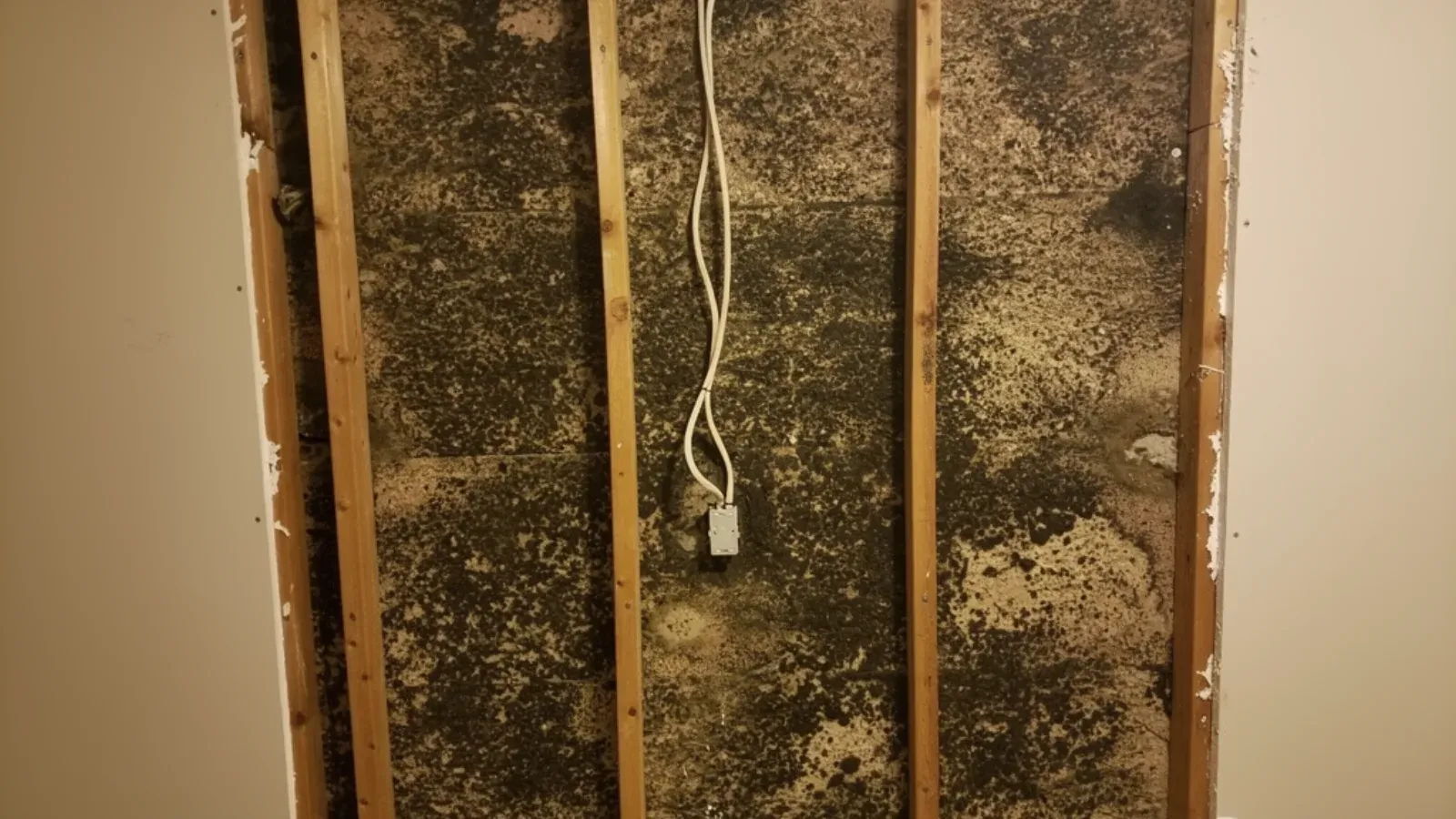
Signs you need this
- • Black, gray, or greenish speckled spotting on a basement wall, often near a rim joist, foundation seam, or below a window well
- • A persistent musty smell in a basement or lower-level room that doesn't go away with cleaning or airing out
- • Drywall that feels soft, crumbly, or slightly damp to the touch in a spot with no known recent leak
- • A household member with unexplained allergy-like symptoms (coughing, congestion) that seem worse in one part of the house
- • A homeowner finally pulls furniture or storage boxes away from a basement wall and sees the extent of the spotting for the first time
- • A home inspection or a real estate transaction flags visible mold or a moisture reading in a basement wall
The Basement Pattern Behind Most Mold Calls
Most of the mold drywall calls we get in Brockton don’t trace back to a single dramatic event. They trace back to a basement wall that’s been quietly damp for months, sometimes years, in a part of the city where the terrain works against dry basements to begin with. The low-lying ground near the Salisbury and Trout Brook watershed means groundwater sits closer to the surface than it does on higher ground toward the West Side, and a foundation wall that’s just barely damp on the inside face all winter is enough to feed mold growth on the drywall behind a finished basement wall long before anyone smells it. By the time a homeowner moves a stack of boxes and sees the spotting, the moisture pattern has usually been established for a while, which is why we treat the visible mold as a symptom and the wall’s moisture history as the actual problem to solve.
Why the Visible Spotting Isn’t the Real Boundary
Mold spreads along a moisture gradient, not in a neat circle you can see from the front of the wall. We check behind and around the visible spotting, often finding the affected area extends further than what shows through the paint, especially where insulation sits directly against the back of the board and holds moisture against it even after the wall surface looks dry. Removing only the visibly spotted section and leaving compromised board next to it is a common shortcut that leads to a callback within a year, so we scope the full affected area up front rather than chasing the problem in stages.
Containment Matters More With Mold Than With a Simple Patch
Cutting into mold-affected drywall releases spores into the air, which is a meaningfully different situation than cutting into a wall for a standard repair. For anything beyond a small, contained spot, we set up containment before demolition starts, sealing off the work area so spores don’t migrate into the rest of the basement or up into the living space above through the HVAC system or an open stairwell. This is standard practice on any job with real coverage, not an upsell reserved for the worst cases.
Where Our Scope Ends and a Specialist’s Begins
We’re direct with homeowners about the line between drywall replacement and mold remediation. If the affected area is extensive, spans multiple rooms, or there’s a concern about air quality throughout the house, that calls for a licensed remediation specialist to handle containment, cleaning, and clearance testing before any new board goes up. Our work picks up from there: rebuilding the wall with mold-resistant board once the space has been cleared. For the more common case, a contained area on one or two walls with an identifiable moisture source, we handle the full job ourselves, from removal through the rebuild.
Building Back With the Right Board, Not Just Any Board
Once the old board and any wet insulation are out and the framing has dried to a safe reading, we rebuild with mold-resistant board rather than standard paper-faced drywall. The fiberglass facing and treated gypsum core resist moisture absorption in a way standard board doesn’t, which matters most in exactly the basement environment that caused the original problem. Pairing that board choice with whatever moisture fix is within our scope, sealing a visible foundation crack, adjusting grading recommendations, or simply flagging a sump pump concern for a specialist, is what keeps the new wall from following the same pattern as the old one.
Materials & standards
Products & materials we use
- National Gypsum Gold Bond
- purple/mold-resistant board (M2Tech)
- DensArmor
- Georgia-Pacific ToughRock
Standards & codes we work to
- Massachusetts State Building Code (780 CMR)
- MassDEP
What the terms mean
- mold-resistant board
- containment
- negative pressure
- moisture source
- basement mold
- rim joist
- foundation seam
- vapor barrier
Options & variants
| Option | When it applies | Cost |
|---|---|---|
| Localized spot removal and replacement | Mold is confined to a small, contained area, source is identified and manageable | Smallest scope, single wall section |
| Full basement wall rebuild with MR board | Mold has spread across a larger wall area or multiple walls in a finished basement | Larger material scope, containment required |
| Containment and coordinated removal | Mold coverage is extensive enough to warrant air quality containment during demolition | Added labor for negative-pressure containment setup |
| Post-remediation rebuild | A separate remediation company has already cleaned and cleared the space, and new board needs to go up | Rebuild only, no removal of contaminated material |
What affects cost
- • How large an area is affected and whether it's one wall or wraps around a corner or ceiling line
- • Whether the underlying moisture source (grading, a sump pump issue, condensation on a cold foundation wall) has already been addressed or still needs a separate contractor
- • Whether containment is needed during removal to keep spores from spreading to the rest of the basement or the house above
- • Whether the replacement uses standard board or mold-resistant (purple/MR) board, which is the standard we use in any space with a history of dampness
- • Access and finish level, since a finished basement with framing, insulation, and trim already in place takes longer to open up than an unfinished utility wall
What to expect
- 1
Assess the affected area
We assess the affected area, checking behind and around the visible spotting to find the true extent, and talk through the likely moisture source with the homeowner.
- 2
Set up containment
If the mold coverage is significant, we set up containment to keep the work area sealed off from the rest of the basement or house during demolition.
- 3
Remove affected material
We remove the affected board and any wet insulation behind it, bagging and disposing of contaminated material rather than reusing it.
- 4
Dry and address moisture
We let the framing dry and confirm it's at a safe moisture level, addressing any accessible moisture issue (like sealing a foundation crack) within our scope, or flagging it for a specialist if it's beyond drywall work.
- 5
Rebuild
We rebuild the wall with mold-resistant board, tape and finish it, and clean the area before we leave.
When this isn’t the right call
- If the mold is tied to a recent, identifiable leak (a burst pipe, a roof failure) rather than long-term chronic dampness, water damage drywall repair is the better fit.
- If the affected wall is original lath and plaster rather than drywall, plaster repair and plaster-to-drywall conversion is the better fit.
- If mold coverage is extensive, spans multiple rooms, or air quality testing is needed, a licensed mold remediation specialist should handle the containment and clearance before we rebuild any walls.
Frequently asked questions
Is this mold remediation, or drywall replacement? +
Drywall replacement. For contained, moderate mold on a wall, we remove and rebuild with mold-resistant board. For extensive coverage or air quality concerns, we coordinate with a licensed remediation specialist first and rebuild after they've cleared the space.
What causes mold on a basement wall if there hasn't been a flood? +
Chronic, low-level moisture is usually the cause: groundwater near the foundation, condensation on a cold wall, or a slow, unnoticed leak. Brockton's lower-lying areas near the Salisbury and Trout Brook watershed see this pattern often, even without a single dramatic water event.
Will the mold just come back after you replace the drywall? +
Not if the moisture source is addressed. New drywall alone doesn't fix a wall that stays damp, which is why we look at the moisture pattern as part of the job, not just the visible mold.
What is mold-resistant board, and is it worth the upgrade? +
It's drywall with a fiberglass facing and treated core designed to resist moisture absorption better than standard paper-faced board. In a basement or any space with a history of dampness, it's the standard we use, not an optional add-on.
Do I need to leave the house during the work? +
For a contained, moderate-size area, usually not. For larger removals where we set up containment, we'll walk through what that means for the rest of the basement or house while work is underway.
How do I know if it's actually mold and not just dirt or old staining? +
Mold typically has a raised or fuzzy texture and a persistent musty smell, where dirt or staining is flat and odorless. When it's unclear, we'll assess in person rather than guessing from a photo.