
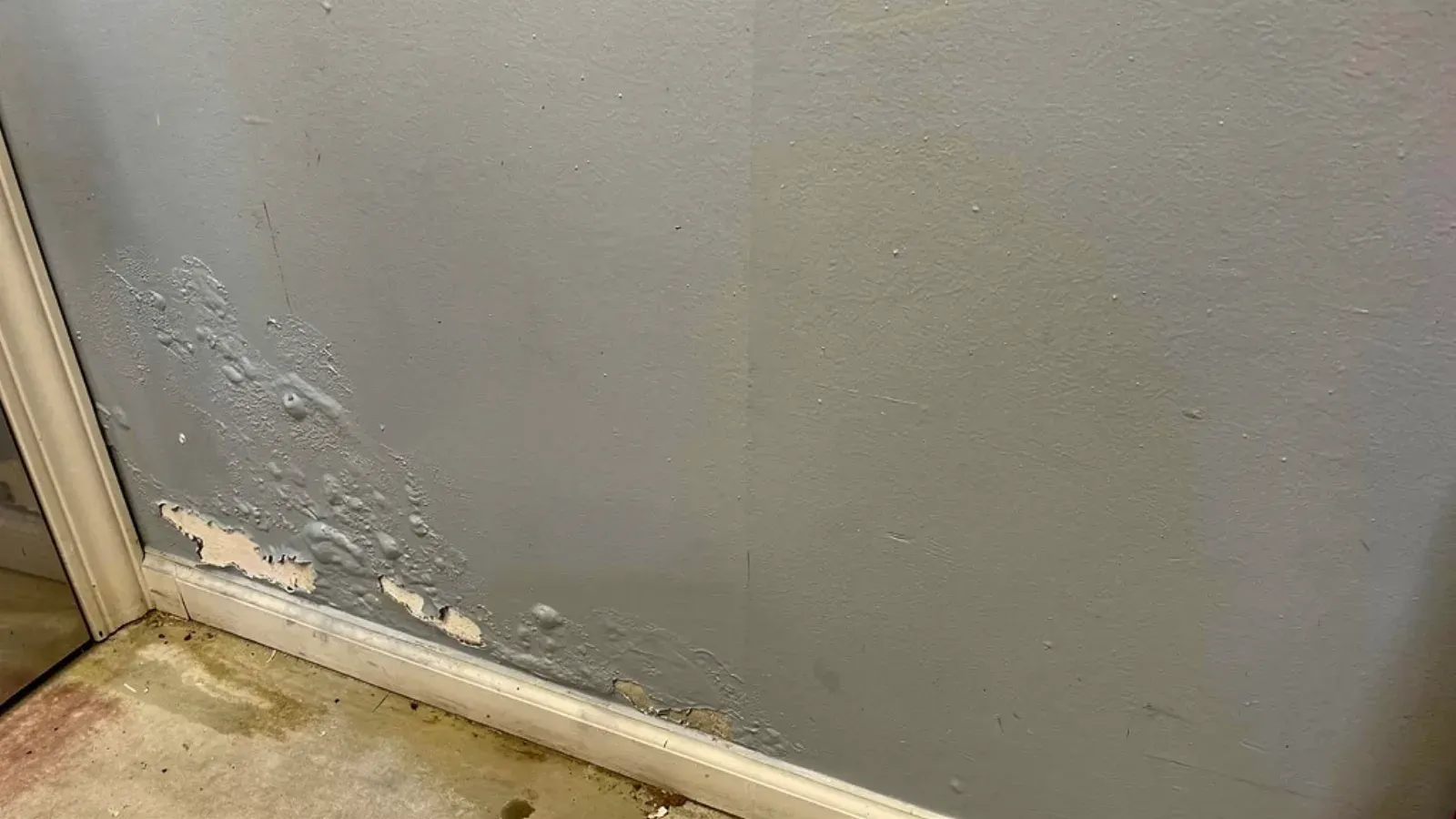
Signs you need this
- • A brown or yellow ring spreading across a ceiling, usually below a bathroom, kitchen, or roof valley
- • A wall that feels soft, cool, or spongy to the touch, or that bulges slightly near a baseboard
- • Paint bubbling or peeling in a straight line that follows a pipe run or window header
- • A musty smell in a room that shows no visible stain yet, usually from a leak inside the cavity
- • A pipe bursts overnight during a hard freeze and water is actively dripping through a ceiling fixture
- • A roof or ice dam leak has been dripping for days and the ceiling has finally sagged or a small hole has opened
What Happens Inside the Wall Before You See a Stain
By the time a brown ring shows up on a Montello triple-decker’s ceiling, water has usually already been sitting inside the joist cavity for days. Gypsum board is a paper-faced material, and once the paper facing wicks up moisture, the bond between the paper and the gypsum core starts to break down long before the stain becomes visible from below. That’s why we never treat a visible stain as the boundary of the damage. We check moisture readings well past the edge of the discoloration, because the water has almost always traveled further along the joist bays than the ceiling paint shows.
Reading the Source, Not Just the Symptom
Brockton’s older housing stock, especially the triple-deckers and two-family homes concentrated in Montello, still runs a lot of original galvanized supply lines and cast iron radiator piping. A hard freeze on a night when a tenant leaves a window cracked, or an unheated back room, is a routine cause of a pipe splitting at a joint. Roof leaks and ice dam backups add a second seasonal pattern: water enters at the roofline, then travels along the sheathing and down through the ceiling assembly before it ever reaches a spot where it’s visible, meaning the wet area on the ceiling below can sit several feet from where the water actually got in. We trace the path before we cut, because opening the wrong section wastes a trip and delays the actual fix.
Why Drying Comes Before Rebuilding
We won’t hang new board over framing that’s still wet. Framing needs to read below roughly 16 percent moisture content on a meter before new drywall goes up, otherwise the new board is exposed to the same moisture that ruined the original and mold has an ongoing source of humidity to work with inside a closed cavity. Depending on how saturated the framing is, that can mean a day or two of air movers or a dehumidifier running in the space before we close it. For a landlord managing a tenant-occupied unit, we factor that drying window into the schedule up front so there are no surprises about how long the room stays open.
Working an Insurance Claim Without Slowing It Down
A meaningful share of this work runs through a homeowner’s insurance policy, particularly for a burst pipe or a sudden roof failure. We document moisture readings and photograph the damage before, during, and after the repair, and we can scope our line items to match what an adjuster has already approved. That paperwork matters as much as the drywall work itself when a claim is open, since a mismatch between the contractor’s invoice and the adjuster’s scope of loss is the most common reason a claim payout gets delayed.
Matching the Finish So the Repair Disappears
Once the new board is up, taped, and coated, the last step is matching the surrounding finish level and texture, whether that’s a smooth Level 5 finish in a formal room or a knockdown texture more common in Brockton’s postwar ranches and capes toward Avon and Stoughton. A patch that’s structurally sound but visually obvious is still an unfinished job in the customer’s eyes, so texture and sheen matching is part of the scope, not an upsell.
Materials & standards
Products & materials we use
- USG Sheetrock
- National Gypsum Gold Bond
- Georgia-Pacific ToughRock
- QuietRock
Standards & codes we work to
- Massachusetts State Building Code (780 CMR)
- ASTM C1396
- GA-214 finish levels
- MA Construction Supervisor License (CSL)
- MA Home Improvement Contractor (HIC) registration (OCABR)
What the terms mean
- moisture meter
- cavity drying
- Level 4/5 finish
- knockdown texture
- orange-peel texture
- joint compound
- corner bead
- Type X board
- scope of loss
Options & variants
| Option | When it applies | Cost |
|---|---|---|
| Spot ceiling patch | Damage is contained to a single stain area with no sag or soft spots around it | Smallest scope, fastest turnaround |
| Full ceiling section replacement | Board has sagged, delaminated, or the moisture reading extends beyond the visible stain | Larger material and labor scope, texture matching required |
| Wall cavity opening and dry-out | Leak has run down inside a wall from a floor above or a plumbing wall | Requires access cuts and a return trip to close after drying is confirmed |
| Insurance-scoped restoration | Claim is open with an adjuster and a documented scope of loss exists | Work follows the adjuster's line items; documentation and photos required |
What affects cost
- • How long the leak ran undetected before discovery, which drives how far the moisture spread beyond the visible stain
- • Whether the ceiling or wall has a texture (knockdown, orange-peel, or a smooth Level 5 finish) that needs matching after the patch
- • Access: a second-floor ceiling under an occupied unit below takes longer than a first-floor wall
- • Whether drying equipment (air movers, a dehumidifier) is needed before we can close the cavity, and how many days that takes
- • Whether the source of the water (a plumber, a roofer) has already been fixed, or still needs to be addressed before we can start
What to expect
- 1
Moisture assessment
We come out and moisture-meter the ceiling or wall, checking well beyond the visible stain to find where the damage actually stops.
- 2
Confirm the water source is addressed
We confirm the water source is addressed, or coordinate with the plumber or roofer if it isn't, before opening anything up.
- 3
Careful demo
We cut back to sound, dry board only, protecting the room with plastic sheeting and containing dust.
- 4
Dry-out confirmation
If the framing is still wet, we set up air movers or a dehumidifier and let the cavity dry to a safe moisture reading before closing it, which can add a day or two.
- 5
Rebuild and finish
We hang new board matched to the existing thickness, tape and coat it to match the surrounding finish level and texture, and clean up before we leave.
When this isn’t the right call
- If the water event happened weeks or months ago and the drywall now shows dark spotting or a musty smell with no active leak, mold drywall replacement is the better fit.
- If the ceiling in question is original lath and plaster rather than drywall, plaster repair and plaster-to-drywall conversion is the better fit.
- If there's standing water in a basement or active flooding beyond a contained leak, a water extraction and remediation company needs to handle the standing water before any board work starts.
Frequently asked questions
How fast can you get to an active leak? +
Active leaks with water still coming through the ceiling get priority scheduling. Get the water source shut off or addressed first, then call so we can assess the extent of the damage.
Will you work directly with my insurance adjuster? +
Yes. We document moisture readings, photograph the damage before and during the repair, and can align our scope with the adjuster's line items.
Do I need to move out while this gets fixed? +
Usually not. Most water damage repairs are contained to one room and don't require the unit to be vacated, though a drying phase may mean equipment running in the room for a day or two.
How do you know the framing is actually dry before you close the wall back up? +
We check with a moisture meter, not by eye or by feel. Framing needs to read below roughly 16 percent moisture content before new drywall goes up, or the new drywall will fail the same way the old one did.
What if the stain comes back after the repair? +
That usually means the original water source wasn't fully resolved. We'll help identify whether it's the same leak recurring or a new one.
Can you match the texture on my ceiling so the patch doesn't stand out? +
Yes, we match knockdown, orange-peel, or smooth finish levels to blend the repaired section into the surrounding ceiling.