
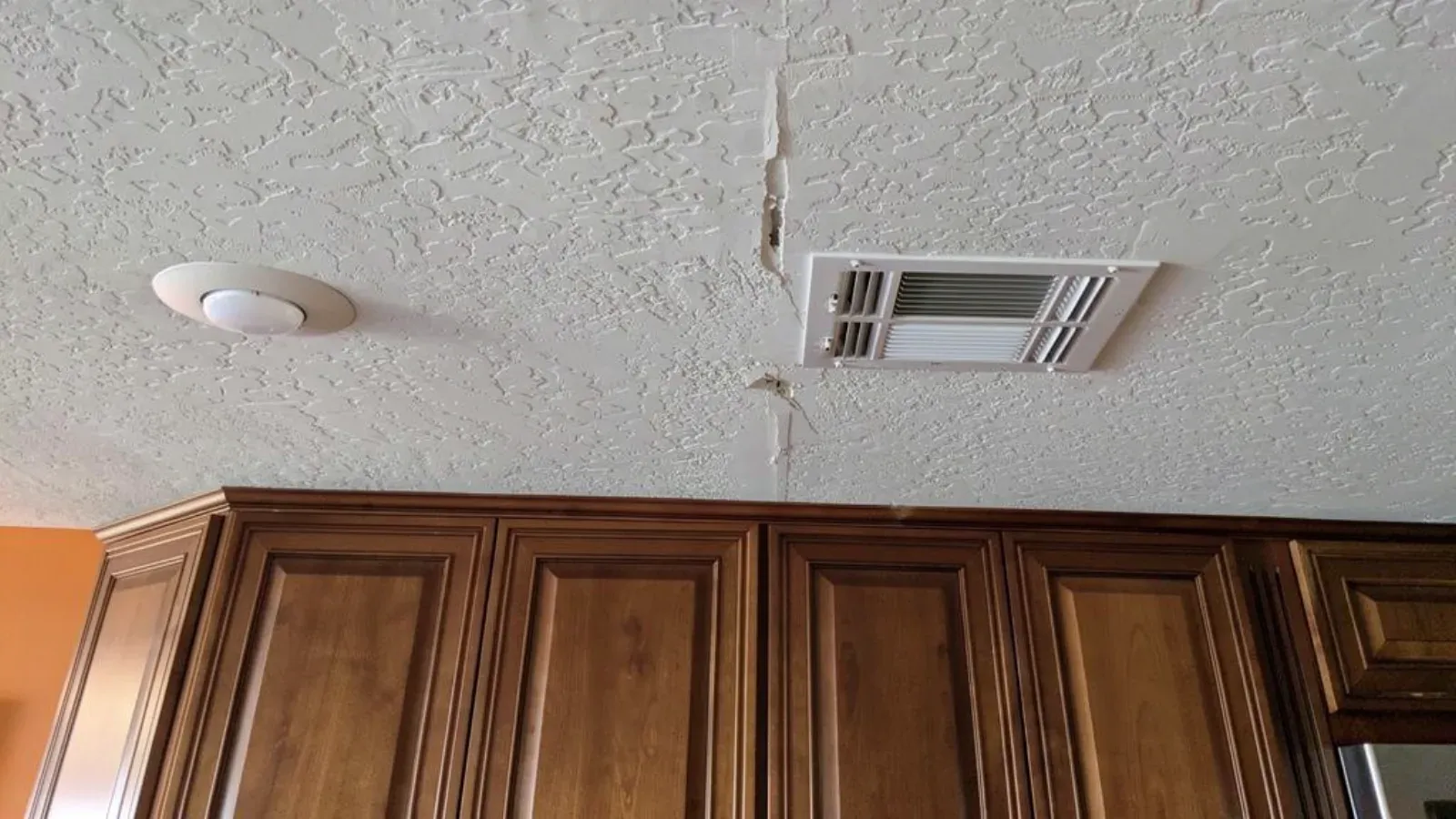
Signs you need this
- • A ceiling that has started to dip or bow in the middle of a room, sometimes visible only from a low angle or in raking light
- • A brown or yellow ring stain spreading across a ceiling, often above a bathroom, kitchen, or exterior wall line
- • A hairline crack running along a ceiling seam or radiating out from a light fixture or ceiling fan box
- • The sag has visible give when pressed, or plaster has started flaking loose onto the floor below
- • A tenant or family member reports water dripping, or a stain has grown noticeably since it was last checked
Plaster ceilings versus drywall ceilings: two different failure modes
Most of the ceiling calls Brockton Precision Drywall gets in Montello’s dense triple-decker blocks start the same way: a tenant or owner notices the ceiling over a bathroom or kitchen has started to sag, and assumes it’s the same fix as a modern drywall ceiling. It usually isn’t. In a home built during Brockton’s shoe-manufacturing boom, the ceiling is almost always lath and plaster: thin wood strips nailed across the joists with wet plaster troweled over them, which squeezed through the gaps and formed small mushroom-shaped “keys” on the back side as it hardened. Those keys are what hold the whole ceiling up. Decades of vibration, roof and plumbing leaks, and simple age cause the keys to shear off one by one, and once enough of them fail in one area, that section of ceiling starts to sag under its own weight, sometimes long before it cracks or falls. A modern drywall ceiling fails differently: water softens the paper face and gypsum core directly, or a poorly fastened sheet works loose at the screws, producing a more localized, faster-moving problem. Brockton Precision Drywall diagnoses which situation is on the table before quoting anything, because reattaching failed plaster keys is a different scope, tools, and price point than cutting out a soaked drywall panel.
Reading a water stain before opening the ceiling
A ring-shaped stain is a map, not just a blemish. Its center usually marks where water first entered, and its outer edge shows how far it traveled before drying, which tells the crew where to expect the worst substrate damage. In Brockton’s older housing stock, roof leaks and ice dam backups in winter are a steady source of this kind of staining, especially on top-floor units in triple-deckers where attic insulation is thin and ice damming along the eaves pushes meltwater back under the shingles. Bathroom and kitchen ceilings on lower floors more often trace back to a plumbing leak from the unit above rather than the roof. Before cutting into a stained ceiling, Brockton Precision Drywall confirms with the customer whether the source has already been addressed by a roofer or plumber; sealing over an active leak just hides the damage behind fresh paint and lets it keep spreading unseen.
Working overhead safely in occupied buildings
Ceiling work carries its own access and safety considerations that flat-wall patching doesn’t. A first-floor ceiling in a ranch or cape is straightforward with a ladder and plank setup, but a stairwell ceiling, a cathedral ceiling in a converted attic, or a ceiling above a stairwell landing in a Victorian on the West Side needs scaffolding or a mechanical lift, and that access cost shows up in the quote before a single cut is made. In occupied triple-deckers and multi-families, Brockton Precision Drywall also plans dust containment carefully, since ceiling demolition drops debris straight down onto furniture, floors, and anything stored below, and a tenant still living in the unit needs a clear, dust-sealed work zone rather than an open room.
Matching an existing ceiling finish so the repair disappears
A structurally sound repair that reads as an obvious patch from across the room is still a failed job in the customer’s eyes. Older plaster ceilings in Brockton’s Victorians and triple-deckers often carry a subtle hand-troweled texture that a flat drywall patch will never match without a skim coat blended into the surrounding plane, especially under the raking light from a bare bulb or a window. Modern ceilings frequently carry a light knockdown or orange-peel texture rather than a smooth finish, which needs to be matched at the patch edge, not just inside it, or the seam will show once the ceiling is painted. Brockton Precision Drywall treats the finish match as part of the repair itself, not an afterthought, feathering compound out well beyond the damaged area so the transition to old material is invisible under normal room light.
When a ceiling repair signals a bigger problem
Not every stained or cracked ceiling is an isolated event. A recurring stain in the same spot after a repair usually means the original leak was never fully resolved, and Brockton Precision Drywall will say so rather than re-patching the same area a second time without addressing the cause. A ceiling with multiple sagging sections spread across a room, particularly in an older plaster ceiling that has never been touched, is often a sign that the whole ceiling has reached the end of its service life and a full re-skin will hold up better and cost less over time than a series of spot repairs. For customers weighing that decision, whether it’s a landlord managing a Montello triple-decker or a homeowner in a West Side Victorian who inherited an untouched original ceiling, Brockton Precision Drywall lays out both options plainly so the customer can choose based on their timeline and budget rather than guessing.
Materials & standards
Products & materials we use
- USG Sheetrock
- National Gypsum Gold Bond
- Georgia-Pacific ToughRock
- FibaTape
- joint compound
Standards & codes we work to
- Massachusetts State Building Code (780 CMR)
- GA-214 finish levels
- EPA RRP (pre-1978 lead-safe practice)
What the terms mean
- lath and plaster
- plaster keys
- skim coat
- mud and tape
- ceiling deflection
- Type X
- raking light
Options & variants
| Option | When it applies | Cost |
|---|---|---|
| Spot patch and skim | Isolated stain or small crack with sound substrate underneath | Lower cost, single visit |
| Plaster key reattachment | Old lath-and-plaster ceiling with loose but unbroken plaster | Moderate, labor-intensive, requires plaster washers or adhesive |
| Cut-out and drywall replacement | Sagging, saturated, or crumbling section beyond reattachment | Higher cost, includes disposal of old material |
| Full ceiling re-skin | Widespread cracking or multiple failed repairs across one ceiling | Highest cost, most consistent long-term result |
What affects cost
- • Whether the ceiling is plaster and lath, which takes more labor to diagnose and repair, or drywall, which is faster to cut and replace
- • Ceiling height and access, since a stairwell or vaulted ceiling needs scaffolding or lift rental that a flat first-floor ceiling doesn't
- • Size and location of the damaged area, and whether it sits near a light fixture, fan box, or HVAC register that has to be worked around
- • Whether the finish is a smooth painted ceiling, a textured ceiling, or a ceiling that needs to match an adjoining skim-coated wall
- • Whether the underlying cause, a roof leak, plumbing leak, or ice dam backup, has already been repaired or needs to be coordinated with another trade first
What to expect
- 1
Describe the damage
The customer calls or requests a quote describing the sag, stain, or crack and roughly how long it has been there.
- 2
Inspect the ceiling
Brockton Precision Drywall visits the property, inspects the ceiling from below and, where safe, from the attic or floor above, and identifies whether the substrate is plaster or drywall and whether the damage is active or resolved.
- 3
Confirm the moisture source
The crew confirms with the customer whether the moisture source has been fixed, and flags it clearly if it hasn't, since sealing a ceiling over an active leak isn't something the company will do.
- 4
Repair and finish
Damaged material is removed, the substrate is reattached or replaced, taped, and finished to match the surrounding ceiling texture.
- 5
Prime and clean up
The area is primed and left ready for the customer's painter, or painted directly if that was included in the quote, and the site is cleaned of dust and debris before the crew leaves.
When this isn’t the right call
- If the crack is one of several recurring cracks along walls tied to house settling rather than an overhead ceiling issue, drywall crack repair is the better fit.
- If the ceiling itself is fine but it's covered in a dated stipple or acoustic texture the customer wants gone, popcorn ceiling removal is the better fit.
- If the whole ceiling needs to come down as part of a larger gut renovation rather than a targeted repair, drywall removal and demolition is the better fit.
- If the repaired ceiling needs to disappear into an existing knockdown or orange-peel texture rather than a plain smooth finish, texture matching is the better fit.
Frequently asked questions
My ceiling has a brown stain but doesn't feel soft. Do I need it repaired right away? +
A dry, stable stain can usually wait a week or two for scheduling, but Brockton Precision Drywall recommends having it looked at soon, because a stain that looks dry on the surface can still mean the gypsum or plaster behind it has lost strength.
Is a sagging plaster ceiling dangerous? +
Yes, a visibly sagging plaster ceiling can release without much warning, especially over a bed, couch, or walkway. Treat visible deflection as urgent and keep the area below clear until it's inspected.
Can you match my old plaster ceiling texture, or will the repair look different? +
Brockton Precision Drywall skim-coats plaster repairs to match the surrounding hand-finished texture rather than leaving a flat drywall patch that reads differently under light, which is common in the city's older triple-deckers and Victorians.
Do you fix the leak that caused the damage, or just the ceiling? +
Just the ceiling. Brockton Precision Drywall repairs the drywall or plaster and can recommend a plumber or roofer, but the water source itself needs to be fixed by that trade before or alongside the ceiling work.
How long does a typical ceiling repair take? +
A spot patch is often a single visit for cutting, taping, and a first coat, with a return trip a day later for finish coats and texture once the compound has dried. A full re-skin takes longer depending on room size and access.
My triple-decker has a ceiling issue in a unit between tenants. Can you turn it around fast? +
Yes, unit-turnover ceiling repairs are common work for Brockton Precision Drywall in Montello's rental stock, and the company can prioritize a fast, documented repair to keep the turnover on schedule.