
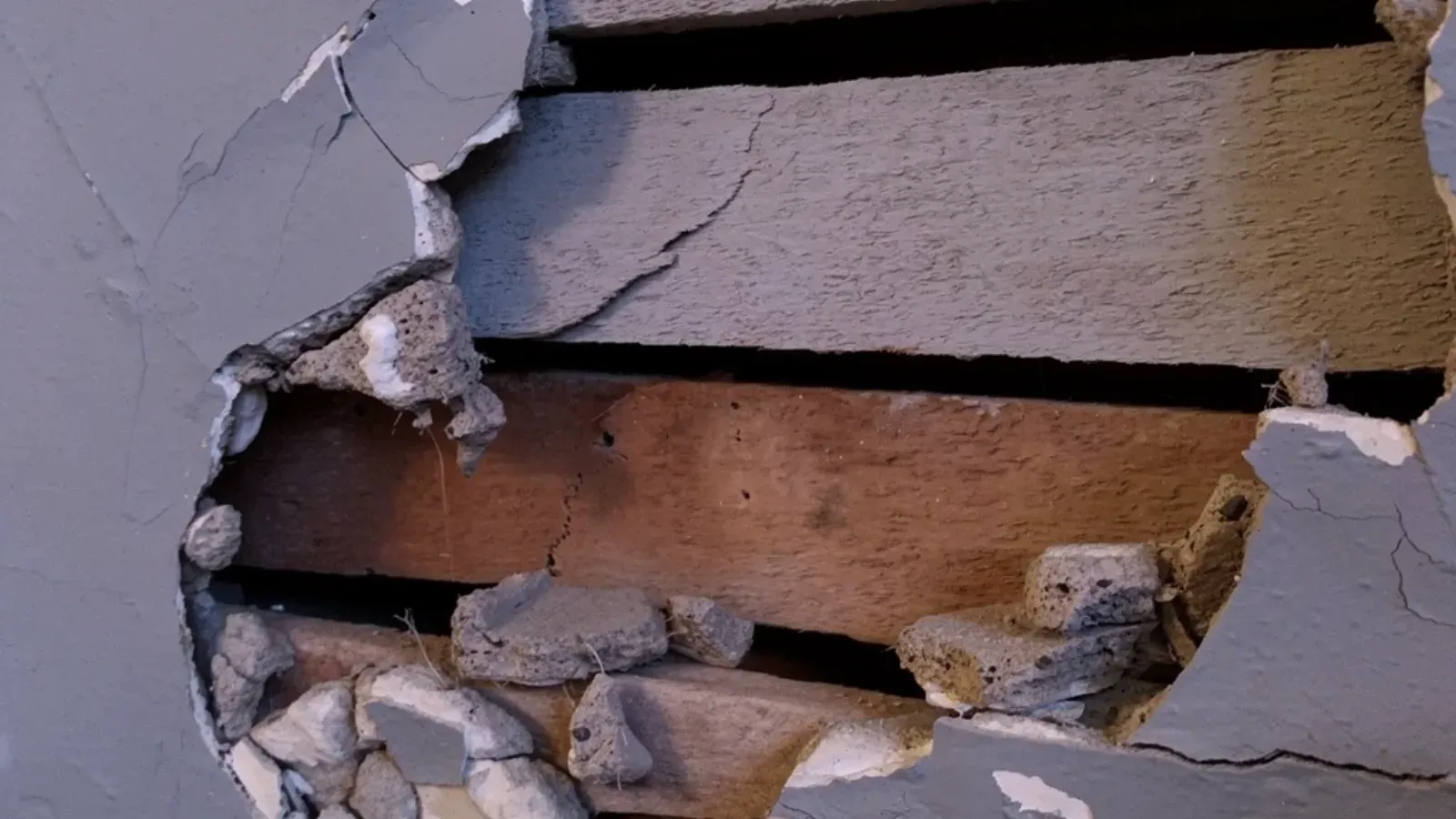
Signs you need this
- • A network of hairline cracks branching out from a doorway or window corner, sometimes running the full length of a ceiling
- • A section of wall or ceiling that gives slightly when pressed, a sign the plaster has separated from the wood lath behind it
- • Chunks of plaster that have already dropped from a ceiling, exposing the lath strips and horsehair-reinforced base coat behind
- • A wavy, uneven wall surface that no amount of paint seems to smooth out
- • A piece of ceiling plaster comes down, sometimes without warning, and the homeowner realizes the rest of the ceiling could follow
- • A homeowner buying or renovating a West Side Victorian gets a home inspection report flagging failing plaster and wants a plan before closing or before starting a larger renovation
Reading a Plaster Wall Before Deciding Its Fate
Every plaster wall in Brockton’s older housing stock, whether it’s a shoe-worker cottage near Campello’s old industrial blocks or a taller Victorian on the West Side, was built the same way: thin wood lath strips nailed across the studs, with a wet base coat pushed through the gaps between them to form small mechanical anchors called keys. Those keys are what actually hold the wall up, not adhesion to the studs. Over eighty or more years, keys crumble, lath dries and shrinks, and the plaster starts to separate from what’s behind it. The crack a homeowner sees on the surface is often the last sign of a problem that’s been developing invisibly for years. We start every job by tapping the surface across the whole wall or ceiling, not just around the crack, because a hollow sound several feet away from the visible damage tells us the keys have already failed there too, even though the plaster hasn’t dropped yet.
The Repair-or-Convert Decision, Room by Room
We don’t treat plaster repair and plaster-to-drywall conversion as two different services, because in practice they’re two outcomes of the same assessment. If most of a wall’s keys are still gripping and the damage is a crack from normal seasonal movement, a targeted patch and skim coat gets the job done at a fraction of the cost and disruption of a full tear-out. If a ceiling has widespread hollow sections or has already dropped plaster, chasing individual cracks is a losing proposition, and converting that section to drywall on the original framing is usually the more durable and cost-effective path. We walk each room on its own merits rather than defaulting to one answer for the whole house, which matters most in a Victorian where one room might have salvageable decorative plaster worth preserving while an adjacent utility room doesn’t.
Lead-Safe Work Is the Default, Not the Exception
Because nearly all of Brockton’s core housing predates 1978, and much of the shoe-era stock predates 1940 entirely, we assume lead paint is present until testing says otherwise. EPA RRP rules govern how we cut, sand, and demolish painted plaster: containment sheeting, specific cleanup and verification steps, and disposal practices that a standard drywall job doesn’t require. This isn’t an optional upgrade we mention for older homes; it’s the baseline we scope from the first estimate on any pre-1978 property, which covers the overwhelming majority of the plaster work we see in this city.
Preserving Character Without Pretending It’s Free
A West Side Victorian with a plaster crown detail or an archway carries character that a flat drywall ceiling doesn’t replicate. Where that detail is worth keeping, we work around it rather than defaulting to demolition, matching new plaster or skim-coated drywall to the existing profile so a repaired section doesn’t read as an obvious patch. That said, historic-sensitive work takes longer and costs more than a standard conversion, and we’re direct about that trade-off up front rather than letting a homeowner discover it mid-project. For rooms without meaningful architectural detail, a straightforward conversion to drywall on the existing framing is usually the more practical choice, and it gives the homeowner a flatter, more paint-ready surface than eighty-year-old plaster ever will.
Materials & standards
Products & materials we use
- USG Sheetrock
- CertainTeed
- National Gypsum Gold Bond
Standards & codes we work to
- Massachusetts State Building Code (780 CMR)
- EPA RRP
- GA-214 finish levels
What the terms mean
- lath and plaster
- plaster keys
- skim coat
- Level 5 finish
- plaster-to-drywall conversion
- historic-sensitive skim
- base coat
- horsehair reinforcement
Options & variants
| Option | When it applies | Cost |
|---|---|---|
| Crack repair and patch | Lath is sound, cracking is cosmetic or from normal settling | Smallest scope, targeted to the cracked area |
| Skim coat resurfacing | Plaster is intact but rough, wavy, or built up with decades of paint | Covers the full wall or ceiling, not a single crack |
| Historic-sensitive restoration | Home has crown detail, archways, or plaster character worth preserving | Slower, more labor-intensive than a standard patch |
| Full plaster-to-drywall conversion | Lath has failed broadly, keys are gone, or the room is already being gutted for renovation | Larger scope, changes wall assembly entirely |
What affects cost
- • How much of the original wood lath is still sound versus how much has separated from the plaster keys
- • Whether the room has decorative plaster detail (crown molding, archways, medallions) that needs to be preserved or matched rather than simply covered over
- • Whether lead paint testing and RRP containment protocols apply, which they do on nearly all Brockton homes built before 1978
- • Ceiling height and access, since Victorian-era rooms in the West Side often run taller than a standard postwar ceiling
- • Whether the job is a targeted repair versus a full room conversion that also touches trim, casing, and outlet extensions
What to expect
- 1
Assess the plaster
We assess the plaster by tapping the surface to find hollow sections and checking how firmly the plaster keys are still gripping the lath behind it.
- 2
Test for lead paint
We test for lead paint where required and set up containment before any sanding, cutting, or demolition begins.
- 3
Repair
For repair, we cut back to sound plaster, patch with a compatible base coat, and skim to blend with the surrounding surface.
- 4
Conversion
For conversion, we remove the plaster and lath down to the framing, then hang new drywall sized to match the original wall thickness so trim and casing still fit.
- 5
Finish
We finish to the room's existing texture, whether that's a smooth historic skim or a standard Level 4 drywall finish, and clean up all debris including the old lath.
When this isn’t the right call
- If the wall or ceiling in question is already drywall, not original lath and plaster, water damage drywall repair or standard drywall patching is the better fit.
- If the plaster damage is from an active or recent water leak rather than age and settling, water damage drywall repair is the better fit.
- If the plaster shows dark staining or a musty smell tied to ongoing moisture rather than a dry crack or sag, mold drywall replacement is the better fit.
Frequently asked questions
Can you match the texture of my original plaster if you convert to drywall? +
Yes. We can skim-coat new drywall to a smooth historic finish so a converted section doesn't look different from the plaster walls in the rest of the house.
My house was built before 1940. Does that change how you work? +
It changes the prep, not the finished result. Nearly all of Brockton's older housing predates 1978, so any work disturbing painted plaster falls under EPA RRP lead-safe practices: testing, containment, and specific cleanup procedures.
Should I repair my plaster or just convert to drywall? +
It depends on how much sound lath is left. If the keys are still gripping and the cracking is cosmetic, repair and skim coat is usually the better value. If large sections sound hollow or have already dropped, conversion is often more cost-effective than chasing failing plaster room by room.
Will converting to drywall mean losing my crown molding or archways? +
Not necessarily. We work around existing trim and architectural detail where possible, and can rebuild or match molding profiles where a section has to come down.
Is plaster repair noisy or dusty for the rest of the house? +
It can be dustier than standard drywall work because of the lath demolition, which is exactly why we contain the work area, especially on pre-1978 homes where lead-safe containment is required.
How do I know if my ceiling is actually at risk of coming down? +
A hollow sound when tapped over a wide area, visible sag, or plaster that's already dropped in one spot are the signs. A crack alone, without sag or hollowness, is usually not an urgent structural concern.